A vaguer script gives you worse pictures
Everyone knows specific writing is better writing. On a faceless channel there is a second, more mechanical reason to care: your script decides what footage exists to use.
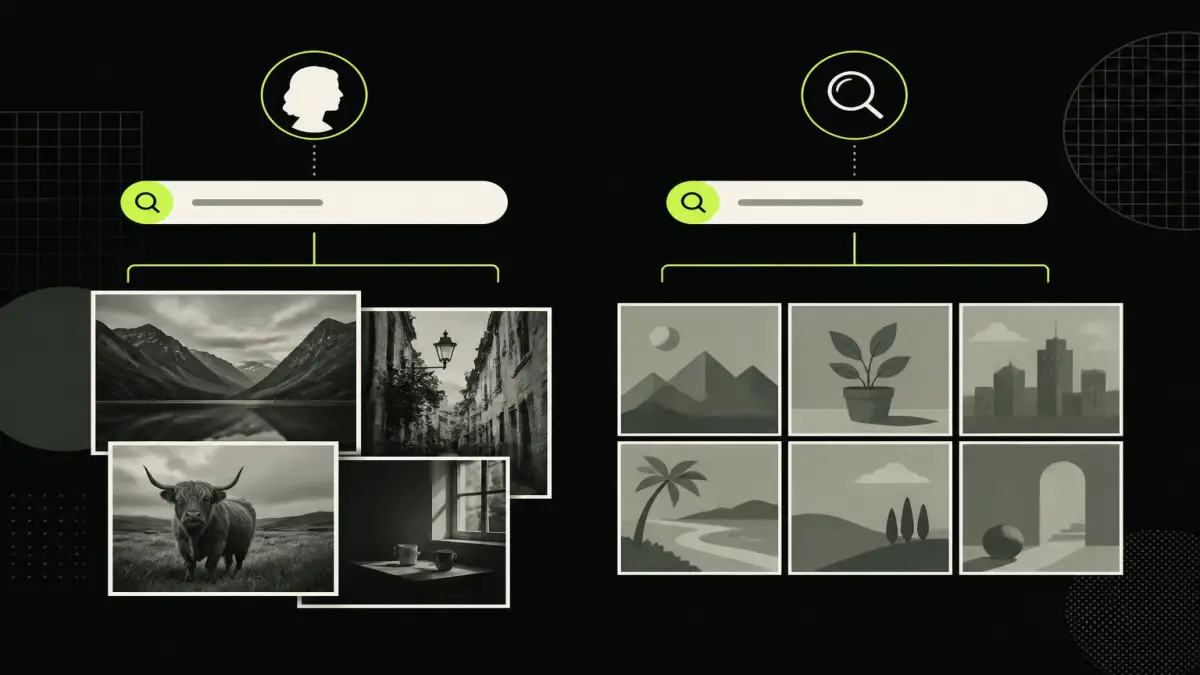
The mechanism
However you source visuals — a stock library, an image search, an archive, your own footage — you can only find what the script actually names.
"An entrepreneur in the post-war years saw an opportunity in freight."
"Malcolm McLean, a trucking operator from North Carolina, watched dockworkers unload his cargo by hand in nineteen fifty-six."
The first sentence can only be illustrated with generic stock. The second one has photographs of a real person, real docks, and a real year.
This is not a preference. It is a hard constraint on what the video can look like, decided at the writing stage and unfixable afterwards.
Why generic stock reads as cheap
Not because stock footage is bad — plenty of it is technically excellent. It reads as cheap because of the *relationship* between the picture and the words.
When a script says something specific and the image shows a generic version of it, the viewer registers the gap. A sentence about a named company over footage of an anonymous office is the video admitting it has no picture of the company. Nobody articulates this; everybody feels it.
The same clips also appear across hundreds of channels, because the pool of clips matching "person looking at laptop thoughtfully" is finite and heavily used.
Two kinds of specificity, two kinds of picture
Worth separating, because they solve different problems.
- Named things — people, companies, places, products, events, dates. These give you *real photographs*. This is the who and the what.
- Mechanisms — how something works, why one thing causes another, what the numbers are. These give you *diagrams and charts*. This is the how and the why.
A script strong on names but with no mechanism produces a video of photographs with nothing to explain. A script strong on mechanism with no names produces diagrams floating free of anything real. Most good videos alternate.
What to write to get better pictures
- Name the entity rather than the category. "Kodak", not "a photography company".
- Give the date rather than the era. Archives are indexed by date.
- Name the place. A city has photographs; "a factory town" does not.
- State the figure. A number is a chart; "a significant increase" is nothing.
- Describe the physical thing where there is one. What it looked like, how big it was, what it was made of.
Notice these are the same instructions you would get for better *writing*. That is the point — the two goals are the same goal, which is why it is worth doing even when the visuals are not your bottleneck.
The limit
This never licenses inventing a name to make the search easier. A specific claim that is false is considerably worse than a vague one that is true — it is checkable, and being caught inventing detail costs more credibility than a plain video ever costs in retention.
Where you genuinely do not have the specific, say the general thing honestly and accept the generic picture. See handling uncertain facts.
Specific and true is the target. Specific and false is the worst outcome available to you — worse than vague.
A check before you record
Read the script and, for each paragraph, write down what would be on screen. Any paragraph where the honest answer is "generic footage of something vaguely related" is a paragraph to rewrite more specifically — or to cut, because it is probably not saying much either.
Doing this before recording is much cheaper than discovering it at the edit, when the narration is already fixed.
Common questions
What if the topic genuinely has no images?
Then it wants diagrams, charts and typography rather than footage, and the script should be written to support those — which means being precise about mechanism and numbers. A topic with neither images nor mechanism is a hard one for this format.
Is AI-generated imagery a solution?
For abstract or conceptual illustration it can be. For anything about a real named person, place or event it is the wrong tool: a generated image of a real subject is a fabrication presented as documentation, which is a credibility problem rather than a stylistic choice.
How to write a YouTube script people actually finish
Most scripts fail the same way: they are correct, organised, and about their subject rather than inside it. Here is what to do instead.
What to do with facts you are not sure about
Rating what you know before you write it — and why openly stated uncertainty reads as more authoritative than false precision, not less.
Which faceless video formats hold attention (and which do not)
Seven formats that work without a presenter, what each one demands of the script, and the one that almost always fails.