Six idea shapes that reliably make good videos
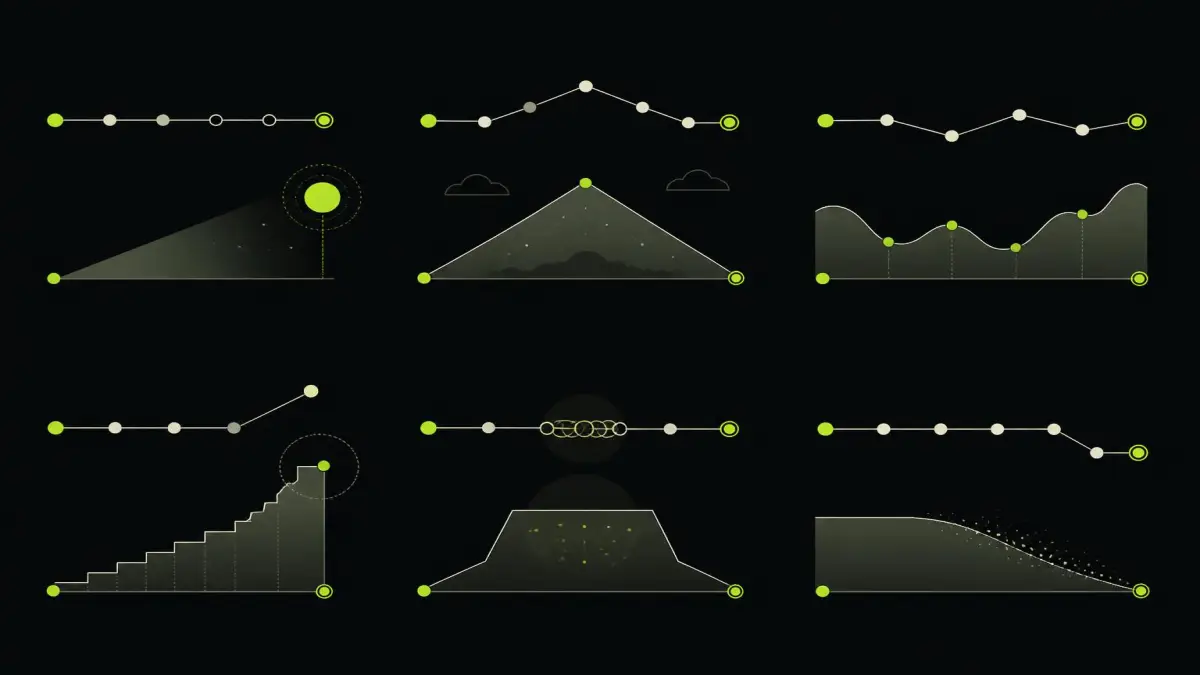
Lists of video ideas go stale immediately and never fit your niche. Idea *shapes* do not: they are structures with tension already built in, and you can point any of them at any subject.
1. The thing that should have worked
Something with every advantage — money, talent, timing, a head start — that failed anyway. The tension is automatic: the viewer knows the outcome contradicts the setup and wants the mechanism.
Works in any niche with named actors. Strong visually, because failures are documented — there are photographs, filings, contemporary coverage.
2. The decision nobody noticed
A small, boring choice that turned out to determine everything downstream. A standard nobody voted on, a default setting, a line in a contract.
This shape is strong because the payoff genuinely surprises: the viewer arrives thinking the cause was the obvious big thing and leaves knowing it was not. It also tends to be underserved, since the obvious cause is what everyone else made a video about.
3. Why it is like that
Something in plain sight with a strange property everyone has stopped noticing. Why train tracks are that width, why the keyboard is in that order, why a form asks for that field.
The hook does the work — once the oddity is pointed out it cannot be un-noticed. Be careful here: these topics attract tidy stories that are widely repeated and frequently wrong. Verify before committing, or the video joins the pile of confidently incorrect ones.
4. The two that look the same and are not
A comparison where the interesting part is that the difference is not what the viewer assumed. Two competitors, two approaches, two standards.
Structurally strong for faceless video because comparison is inherently visual — side-by-side, chart, table — so the pictures have something to do throughout.
5. What it actually takes
The unglamorous full accounting of a process everyone has a vague idea about: what it costs, how long it takes, how many people, what goes wrong. Scale is the payoff.
This shape lives on real figures, which makes it strong when you have them and unmakeable when you do not. Do not fill the gaps with plausible-sounding numbers — see handling uncertain facts.
6. The moment it changed
A specific date, decision or event where a before and an after are genuinely different. Not a history of a thing — the hinge.
Naturally satisfies the "what changes between the first line and the last" test that most videos fail, because the change is the premise.
Using them
Take your niche and run all six against it in one sitting. You will get more usable ideas in an hour than from a month of waiting for inspiration, and they will be structurally sound rather than merely on-topic.
Then run each survivor through the three-part test in topic research: would anyone ask this, is the answer non-obvious, can you actually answer it.
Finding topics worth making a video about
The difference between a subject and a topic, where good ones actually come from, and the test that kills most of your ideas before you waste a week on them.
Studying competitors without copying them
What to actually look for in other channels — and why copying the thing that made their video work usually fails.
A structure for scripts that hold to the end
Five parts, what each one is for, and the specific place in the middle where most scripts quietly die.