Why a narrow niche beats a broad one
Going narrow feels like turning down audience, which is why people resist it. The mechanism is the reverse: a narrow channel is *easier* to get watched, and the reasons are specific rather than motivational.

What narrow actually means
Not a smaller subject. A specific *kind of video*.
A channel about business.
A channel about companies that were market leaders and no longer exist, one company per video.
The second one tells you what every future video looks like. That is the property doing the work.
The test: can a stranger predict what your next video will be like, without predicting its topic? If yes, you are narrow enough.
Mechanism one: recommendation needs something to match
Recommendation works by finding people who liked things like this. A channel where every video is a similar treatment gives the system a consistent pattern to match against, and each successful video makes the next one easier to place.
A channel where video one is a company post-mortem, video two is a productivity list and video three is a news roundup gives it three unrelated signals. Each video starts from scratch.
Mechanism two: research compounds
This is the practical benefit nobody mentions and it is large.
In a narrow niche, the fifth video is faster to make than the first. You already know the sources, the recurring names, the standard objections, the terms practitioners use. Context carries over.
In a broad niche it never carries over. Every video is a cold start, which means either the research stays shallow or the cadence collapses. Usually both.
Mechanism three: you can be the best at something
You cannot be the best channel about history. You can plausibly be the best channel about a specific category of engineering failure, because roughly nobody is trying.
That matters because "best available video on this exact question" is a reachable position, and it is what gets a video recommended over an equally competent one from a bigger channel.
Narrow and deep travels further than broad and shallow — and it is the only one of the two a new channel can actually execute.
The fear, and whether it is real
The objection is always the same: I will run out of topics.
In practice this is rare. Channels overwhelmingly die from being indistinguishable, not from exhausting a subject. And a narrow niche that genuinely runs dry after fifty videos has, by then, given you an audience and a reputation you can widen from — which is a far better position than the one broadness starts you in.
The honest failure case exists though: a niche so narrow it has eight topics. The twenty-topic test in choosing a niche is what catches it.
Widening later
The right sequence is narrow first, widen from strength. Once a channel is known for one thing, adjacent material carries: people came for the specific thing and will follow you slightly outward.
The reverse — starting broad and hoping to find focus — does not work, because there is no established thing for the widening to extend from.
Common questions
How narrow is too narrow?
When you cannot list twenty distinct videos. That is the operative limit, and it is a much lower bar than most people assume — a well-chosen narrow niche usually generates more topics than expected once you are inside it.
Does a narrow niche limit how big the channel can get?
Eventually, yes — every subject has a ceiling. That constraint binds much later than the one that actually kills channels, which is not being distinguishable enough to get watched at all.

Choosing a niche for a faceless channel
How to pick something to be about that has demand, that you can still stand in six months, and that you can actually get pictures for.

How to check whether a niche is worth entering
A concrete check you can run in twenty minutes with search results alone — no keyword tool required.
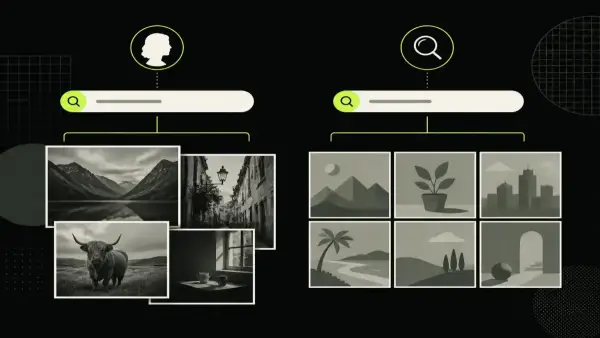
A vaguer script gives you worse pictures
On a faceless channel, generic writing has a second cost most people never connect to the script: it determines what you are able to put on screen.